I found this article/research interesting as it could give some investment ideas on future tech trends.
And perhaps, creating a debate on it and talking about possible ways to invest in it (stocks, ETFs, Investment Trusts, etc).
BofA Global Research strategists led by Haim Israel release a 152-page research report identifying 14 “radical technologies that could change our lives and accelerate the impact of global megatrends.”
6G : “The next generation of telecom networks will be needed in less than a decade as data continues to grow exponentially and 5G reaches its upper limit capacity.”
Brain Computer Interfaces : “As we reach a point where humans are unable to keep up with computers and AI, brain computer interfaces could help ‘level up’ humans with computers. Shorter term, brain computer interfaces hold solutions for paralyzed individuals and promise a new wave of innovation in gaming.”
Emotional Artificial Intelligence : Also “known as ‘Affective Computing’ and ‘Cognitive Computing’ (it) is designed to capture, analyze and respond to human emotions and simulate human thoughts. EAI can potentially collect, analyze and respond to completely new varieties of data and situations and predict or simulate human thought, leading people to take action.”
Synthetic Biology : “At its core, ‘synbio’, as the field is commonly referred to, takes advantage of the vast diversity of nature to make biomolecules that traditional chemistry cannot.”
Immortality : “Traditionally, aging has not been viewed as a disease that can be treated but this is changing. Actors in this space are increasingly looking to tackle the hallmark of aging via pathways such as ‘genomic instability, telomere attrition, mitochondrial dysfunction, and cellular senescence’ among others.”
Bionic humans : “This could be invasive (e.g. implants) or non-invasive (e.g. exoskeleton). Biohacking is also an associated field which is essentially applying DIY biology to boost oneself e.g. RFID chip in hand for contactless payments.”
eVTOL : “Electrical vertical take-off and landing vehicles that could provide an alternative mobility transportation solution to outdated infrastructure and overly stressed roads in urban settings.”
Wireless Electricity : “As the IoT takes off, automating and creating near continuous charging solutions could provide convenience for consumers, while solving charging problems for the rollout of EVs and secure electricity supplies for remote communities.”
Holograms : “A technology capable of creating a simulated environment through light imagery projections that will allow everyone to come together in one virtual room, without having to leave their physical location.”
Metaverse : A “future iteration of the Internet, made up of persistent, shared, 3D-shared spaces linked into a virtual universe. It could comprise countless persistent virtual worlds that interoperate with one another, as well as the physical world and transforming markets such as gaming, retail, entertainment etc.”
Nextgen Batteries : “Whilst lithium batteries are the major EV technology, this does not necessarily need to stay true with alternatives such as solid state, vanadium flow, sodium ion etc provide promising additional attributes.”
OceanTech : “It seeks to answer: ‘How do we increase sustainability of the ocean economy while harnessing its benefits?’ Solutions could include ocean energy, land-based aquaculture, and precision fishing using AI, etc.”
Green Mining : “Transitioning away from a carbon-intensive economy will mean moving to a metal-intensive one. Green mining solutions like deep-sea mining, agromining, mining of wastewater and asteroid mining could provide less polluting and destructive solutions as the green economy’s thirst for metals grows.”
Carbon Capture & Storage : “All current zero-carbon pathways require some form of CO2 removal. CCS, alongside other geoengineering solutions, could act as part of the solution with long-term permanent removal of CO2 vs afforestation.”
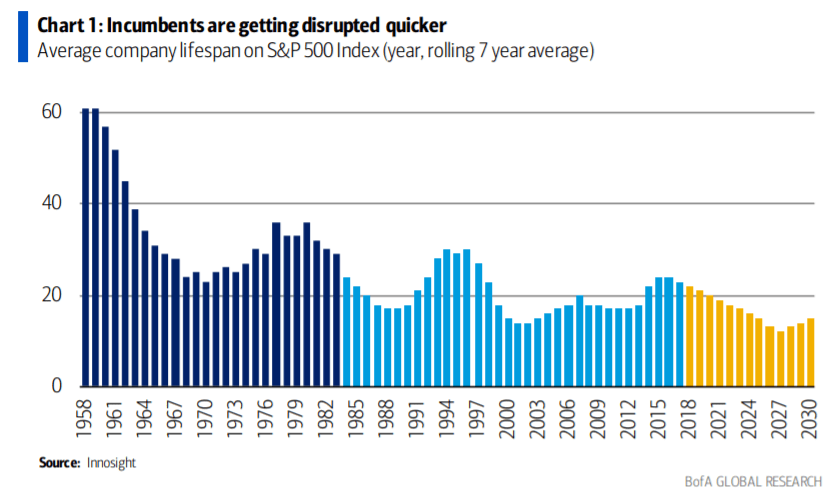
Lower lifespan . The lifespan of S&P 500 (SP500) (NYSEARCA:SPY) incumbents is shortening and by 2027 components could last just 12 years before being replaced, BofA says.
Getting earlier into the next big thing has been crucial for one’s success in stock investing. In the past three decades, just 1.5% of companies accounted for all the wealth created in the global stock market, BofA said, citing a study from Hendrik Bessembinder, an Arizona State University professor.
Meanwhile, incumbents are displaced at a faster rate because of accelerating innovations. Take the life span of S&P 500 companies for instance. In 1958, the average company lasted 61 years. That has shortened to 24 years by 2016 and is expected to be halved to just 12 years by 2027, BofA data show.
(…)
Investing in early innovators often requires a strong stomach for losses, both in terms of the bottom line and stock performance. For instance, a Goldman Sachs Group Inc. basket of non-profitable tech firms in innovative industries tumbled almost 40% earlier this year and has yet to recoup half of the losses. And certainly, not everyone will be able to succeed.
To BofA’s Israel, the reward from investing in the stars of tomorrow isn’t insignificant. By his team’s estimate, the 14 technologies highlighted for the future currently represent only $330 billion in market size. Combined, they could increase 36% a year to $6.4 trillion by the 2030s. For context, profits from S&P 500 companies have grown 6% a year historically.
“These moonshots could transform and disrupt multiple industries, contributing to the next big cycle of technology-driven growth,” the strategists wrote.
Musk don’t have a company in the “Brain Computer Interfaces” (2.) sector?
Does cryptos (especially the NFTs) qualify for “Metaverse” (10.)?
When I read the 9th (“Holograms”), I remember a concert from Gorillaz, with video projection images of the elements of the band, I don’t know if we can call that holograms…
For the most part this seems to be a semiconductor/cloud etf basically. I’m surprised with the exposure to Nvidia, Intel, Taiwan Semi, Qualcomm etc. that ASML has not made an appearance.
" * The suits are circling. In the wake of Facebook’s new positioning as a Metaverse company, execs at a multitude of tech and media outfits have put it front and center of their strategy, or are at least saying they have a Metaverse strategy. Leading the pack are game engine companies like my employer Unity and graphics chip powerhouses such as NVIDIA. These companies are laying the groundwork by delivering miraculous real-time 3D tech on a regular basis, and they are built on solid business models delivering significant commercial value. They will indeed be foundational for the Metaverse. But these days you can’t swing a dead cat without hitting an ad agency or tech startup that has the word Metaverse in a strategy deck, too. Sensing a Next Big Thing, people don’t want to have to play catch-up like they did with the Internet or mobile. Mind you, the term Metaverse isn’t new, nor is the vision, despite various attempts at rewriting history. But now that His Eminence has given voice to it, the Metaverse exists by fiat. So let it be written; so let it be done. And everyone is pouring in."
Most people already have Top Metaverse stocks part of S&P 500 funds or Vanguard Life Strategy:
NVDA NVIDIA CORPORATION
MSFT MICROSOFT CORP
FB META PLATFORMS INC
AMZN AMAZON COM INC
It is probably just need to add/to add more:
RBLX ROBLOX CORP
U UNITY SOFTWARE INC
ADSK AUTODESK INC

 , as if we’re not over crowded enough


